Notes from the presentation to the INTERNATIONAL SCHOLARLY CONFERENCE: Reimagining and Rebuilding Palestine: Genocide, Trauma, and the Future of a Suffering Nation
30-31 January 2026
Universitas Foundation and the University of Cyprus
Nikos Moudouros
Let me begin with two scenes.
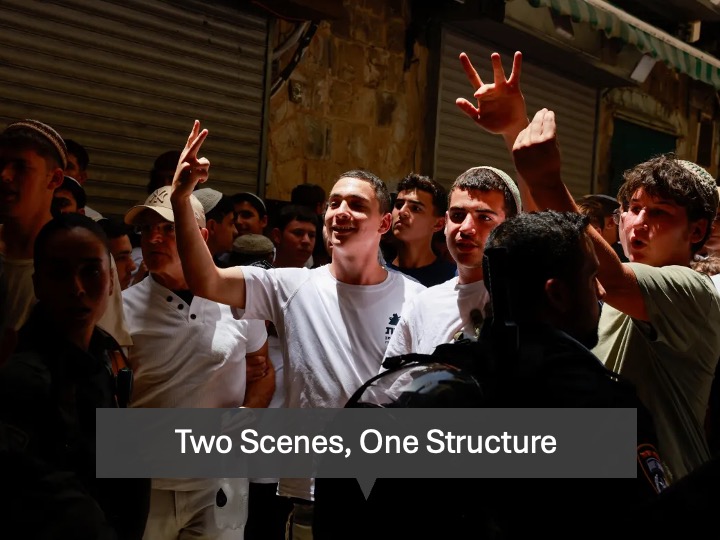
In May 2025, several thousand Israelis affiliated with far-right groups took part in the annual “Flag March” through the Muslim Quarter of Jerusalem’s Old City. Participants chanted openly racist slogans: “Death to Arabs,” “May their villages burn.” One banner read: “Jerusalem 1967, Gaza 2025,” explicitly linking the occupation of East Jerusalem to the desired annexation of Gaza. This march was not marginal. It was municipally funded, and prominently attended by Israel’s Minister of National Security, Itamar Ben-Gvir, who shielded those involved in attacks on Palestinians.
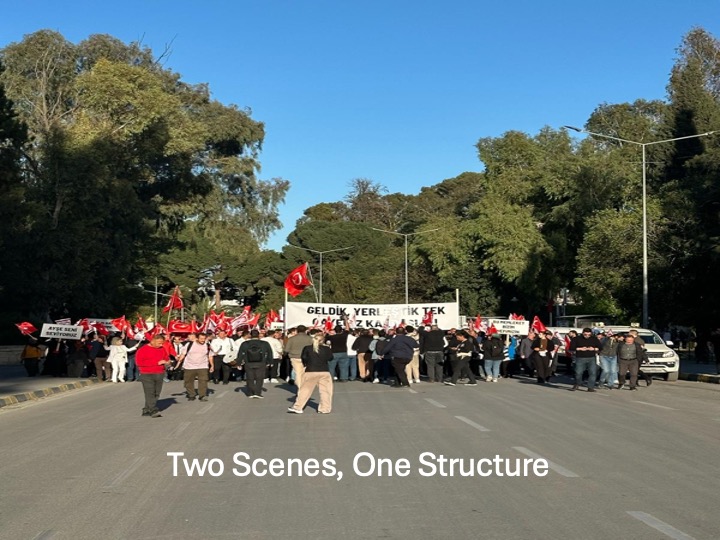
A month earlier, in April 2025, around three hundred Turkish settlers gathered outside the Turkish embassy in the northern part of Nicosia. Most were supporters of Erhan Arıklı, leader of the far-right Rebirth Party and member of the coalition government. Their stated aim was to support Ankara against mass Turkish Cypriot protests defending secular education and generlly the secular way of life of the T/C Community. Those protests were framed by Arıklı as provocations against the “motherland.” Slogans included: “Cyprus is Turkish and will remain Turkish,” “No one can stand against the Motherland,” and “We came, we settled.”
At first glance, these two events appear unrelated. They unfold in different regions with different historical trajectories. Yet I argue that they are connected by a shared structure: the maturation of far-right settler politics as a project not only of territorial control, but of an attempt to construct a settler demos – a political community that claims to embody the only legitimate popular will.
Settler Colonialism: A Brief Theoretical Grounding
To make this comparison meaningful, we need to situate both cases within settler colonial theory.
As we know, settler colonialism is not simply another form of colonial domination. It is a variant of colonialism whose central aim is the permanent replacement of Indigenous populations by settlers.
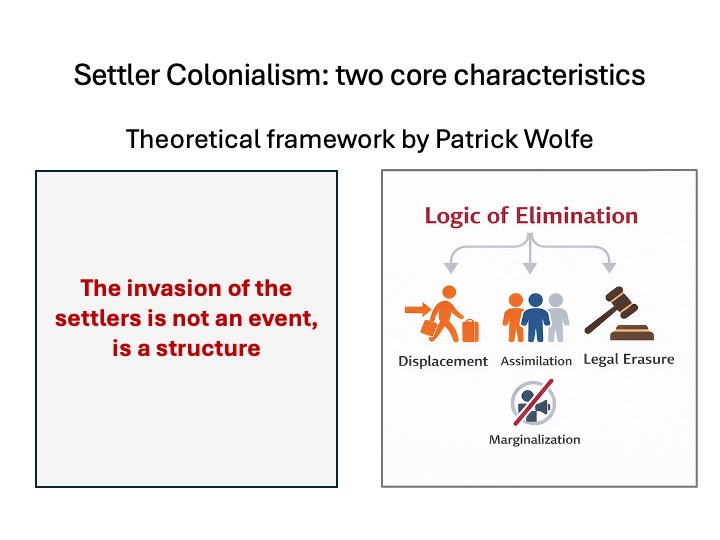
Two of the most referenced aspects of Patrick Wolfe’s analysis of the settler colonial phenomenon are the following:
- First, the invasion of settlers is not an event, but a structure. It does not end with the moment of conquest or occupation. It persists over time through law, institutions, political norms, and everyday practices that normalize settler presence.
- Second, settler colonialism operates through what Wolfe called a logic of elimination. Elimination does not necessarily take the form of genocide or ethnic cleansing. It can unfold through displacement, assimilation, legal erasure, or political marginalization.
The epicenter of this is the destruction of Indigenous sovereignty, so that a new political and social order can be built on appropriated land.
The case of Palestine fits into this “classical” framework, alongside the archetypal cases of settler colonialism such as the United States, Australia, New Zeland.
But what about Cyprus?
Cyprus and Twentieth-Century Settler Colonialism
The Turkish invasion of Cyprus in 1974 and the subsequent large-scale settlement of Turkish populations in the northern part of the island, constitute one of the clearest cases of settler colonialism in the late twentieth century.
Yet this process is rarely analyzed as such. It is more often framed through occupation, geopolitics, or international law.
I would like to propose to analyse Cyprus – the demographic engineering – taking place through a new typology of “20th century settler colonialism”, which is structured around a dynamic quadrangular relationship (and which is valid also to other cases in the 20th century, like the colonization of Poland by the Nazi Germany, the colonization of parts of Africa by fascist Italy, or even the colonization of Algeria by France): the metropolitan state, the local administration, the settler population, and the Indigenous community. (For this analysis I follow the model analyzed in the collective volume by Elkins & Pedersen). Cyprus fits this model closely, but with an important degree of fluidity.
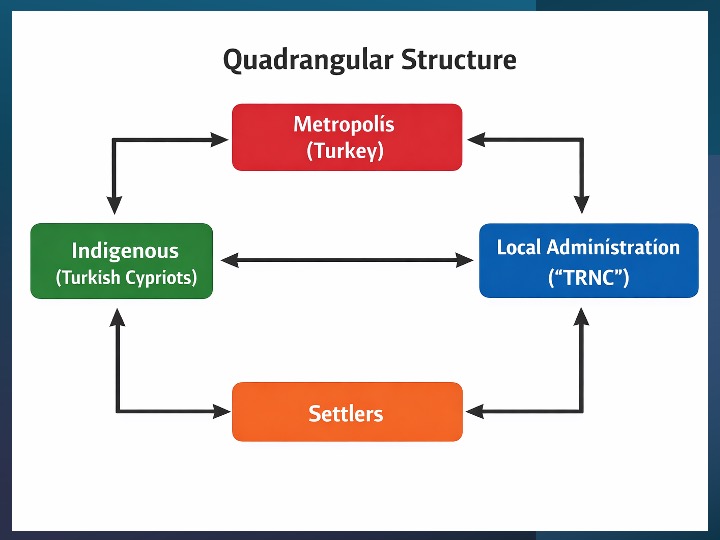
Turkey organized the colonization after 1974, while the local administration (expressed by the T/C nationalist elite) functioned as the institutional mechanism trying to integrate settlers and distribute resources.
What makes this case distinctive is the long-standing, unstable balance between settlers and Indigenous Turkish Cypriots. For decades, cultural and social capital largely remained in the hands of the Indigenous population, particularly in education, public institutions, and everyday cultural life.
Settlers, who were generally class-disadvantaged, were unable to establish ideological or cultural hegemony. Their strategic significance was articulated primarily through their numbers. Today, settlers constitute roughly 45 percent of the electorate, with an upward trend, making demographic weight their main source of political leverage. But still we are not referring to a homogenous population with one and only political will.
From Land to Democracy: The Settler Demos
This brings me to one of the central concepts of my argument: settler demos.
The settler demos refers to the political community formed by settlers as the de facto bearer of sovereignty.
Settlers come to claim that they are “the genuine people,” that they embody the democratic will of the territory. In this context, universal values operate as tools of elimination.
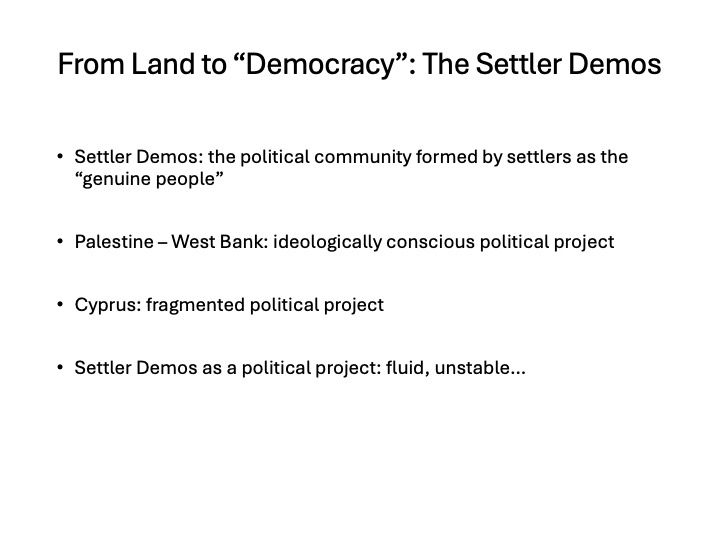
In the West Bank, the settler demos has emerged as an active, ideologically conscious, and often state-integrated political subject. Settlers do not merely occupy land; they increasingly define the boundaries of political belonging.
In Cyprus, the construction of a settler demos has been more fragmented. Ideological coherence has largely been confined to settler elites, rather than deeply internalized across the settler population as a whole.
The settler demos, then, is not automatic. It is a political project – one that can succeed, partially succeed, or fail.
The Far Right as the Purest Expression of Settler Colonialism
It is at this point that the far right becomes central.
In Israel, the contemporary far-right draws heavily on fundamentalist Zionism. Movements such as Gush Emunim, and later Kahanist currents, articulated a worldview in which settlement and colonization of Palestine becomes a sacred duty.
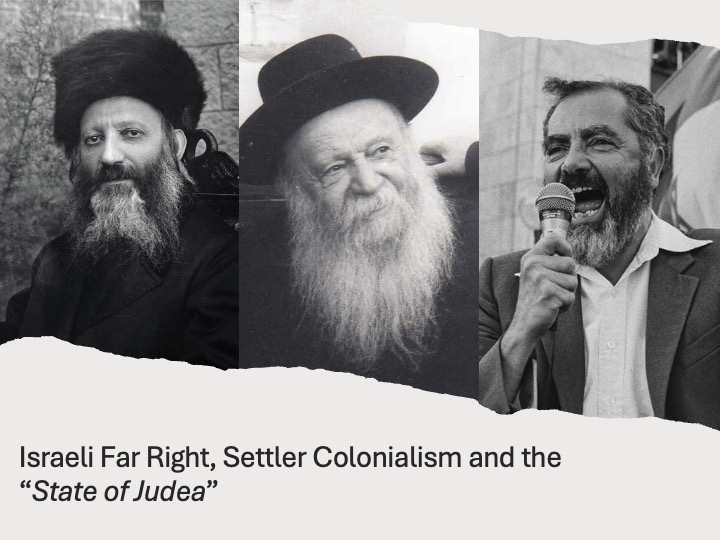
Key ideological figures are Isaac Kook and (his son) Yehuda Kook.
They provided religious legitimacy to Zionist settlement by framing secular political action as the unconscious execution of divine will. The secular state was understood as a transitional vessel for redemption. Human action was required to accelerate the redemption of the Jews.
This logic is radicalized in the thought of Meir Kahane, whose ideology was openly fascist. Kahane advocated expulsion, ethnic purification, and the normalization of violence as a tool of national rebirth. His influence, once marginal, is now visible at the highest levels of Israeli politics.
Itamar Ben-Gvir embodies this trajectory. A resident of Hebron, one of the most violently contested sites of colonization, Ben-Gvir represents the ideologically conscious settler as a direct bearer of sovereignty. His populist appeal draws on social and ethnic inequalities within Jewish Israeli society – particularly among Mizrahi communities – and redirects them toward a politics of annexation and exclusion.
The most far-reaching outcome of these processes is the ideological ascendancy of what Ilan Pappé has called the “State of Judea.” This refers to the political and ideological alliance between the far right and fundamentalist Zionism, which now claims that the secular Zionist elite has fulfilled its historical role and that the Judaization of Palestine should be carried forward under its own political leadership. In this framework, sovereignty is no longer merely territorial or administrative, but takes an intensified form of state building project in the West Bank.
Turkey, Cyprus, and Settler Populism
In Cyprus, far-right settler politics takes a different form.
Cyprus is constructed ideologically as a Turkish homeland: one that must be emptied, and rebuilt.
Part of the Indigenous population is expelled (G/C); another part is ideologically assimilated (T/C).
In this way we can speak about the cypriot terra nullius in 1974 and later the creation of a new “turkish” homeland in the North.
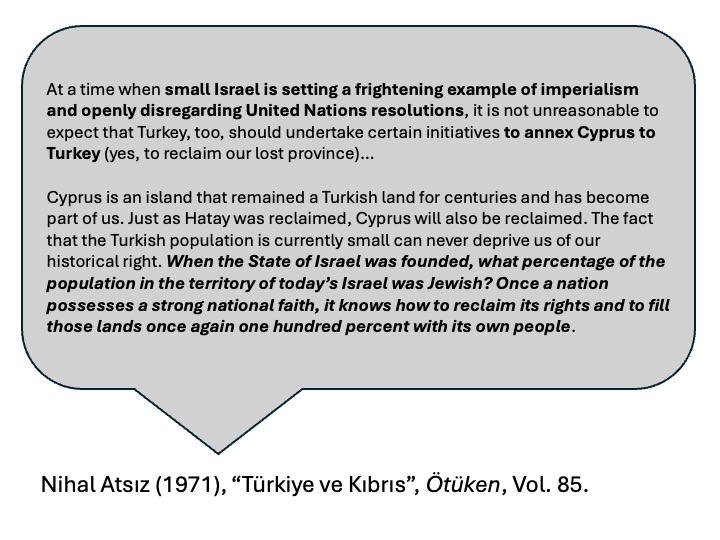
This logic is clearly articulated by figures such as Nihal Atsız, who in 1971 explicitly invoked Israel as a model, arguing that demographic transformation follows conquest of the land.
Yet unlike the Israeli case, ideological settler consciousness in Cyprus has not been broadly internalized. Most settlers arrived from poor, rural regions of Anatolia, driven by the need for survival rather than messianic belief.
Ideological coherence is concentrated in settler elites (political leaders, organizers, and far-right networks) who articulate victimhood narratives and mobilize loyalty to the “motherland.”
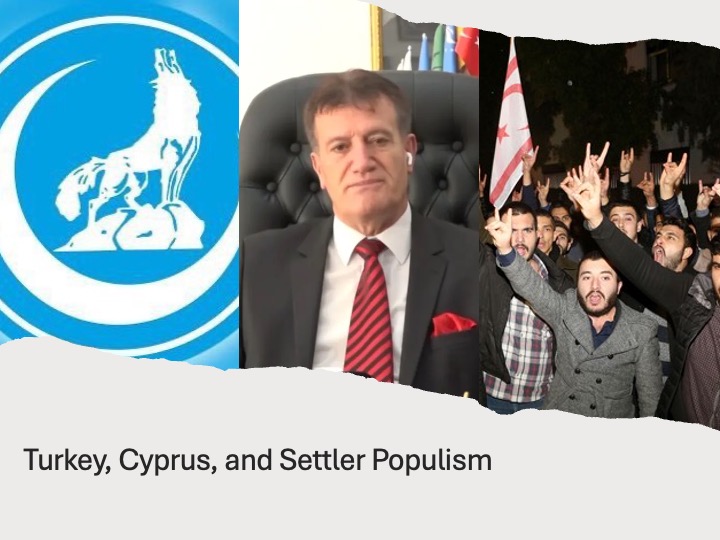
Erhan Arıklı and the Rebirth Party exemplify this pattern. Their populism constructs settlers as “second-class citizens,” contrasts “white” and “black” Turks, and portrays Turkish Cypriot dissent as betrayal. The goal is not autonomous sovereignty, but disciplined alignment with Ankara. The settler demos here is (for the moment) aspirational, not hegemonic.
Conclusion: Democracy as the Final Frontier
These kind of comparisons show that far-right settler politics is not an anomaly within settler colonialism and its various forms taking place in Palestine and Cyprus. It is one of its most coherent expressions.
By focusing on the settler demos, we can see how domination today operates not only through land, violence, or demography, but through democracy itself. The far right seeks to monopolize the definition of “the people,” rendering Indigenous populations politically illegitimate, disloyal, or incompatible with democracy.
What differs between Palestine and Cyprus is not the underlying logic, but its social depth and institutional reach. In the West Bank, ideologically motivated settlers increasingly reshape the state from within. In Cyprus, settler power remains more dependent, more hierarchical, and more contested.
Yet in both cases, these projects remain unstable. They require constant mobilization and repression. Precisely because the settler demos must be constructed, it can also be challenged.
Palestinian resistance and Turkish Cypriot opposition remind us that settler claims are never complete. Ultimately, the struggle in settler colonial contexts is not only over territory. It is over who gets to count as “the people” – and over what democracy is allowed to mean.
 ΑΝΑΤΟΛΙΚΟΤΕΡΑ